
The future of personalized dermatology — precision-based interventions tailored to an individual’s genetic makeup, skin biology, and lifestyle — is undergoing a radical transformation thanks to the emergence of genomics, proteomics, and artificial intelligence (AI). Genetic profiling, particularly single nucleotide polymorphism (SNP) analysis, allows dermatologists to identify individual predispositions that may influence skin health and treatment response. Proteomics maps protein interactions within the body, while AI integrates genomic data with imaging, lifestyle, and environmental information. Together, these technologies can unlock individualized solutions that enhance treatment and improve patient outcomes in ways that were previously unimaginable.
Genomics and Personalized Dermatology
Genomics is the study of the entire genome, bringing together genetic and epigenetic information and offering clinicians new opportunities to improve diagnoses and treatment. Genomics can drive personalized dermatologic care by revealing individual predispositions that influence skin health and treatment response. By identifying Single Nucleotide Polymorphisms (SNPs) linked to dermatologic outcomes, genomics can help dermatologists assess, diagnose, and treat patients more efficiently.
Examples of SNPs that have been associated with dermatologic outcomes include:
- MMP1 – collagen degradation; guides collagen-stimulating therapies.
- SOD2 – oxidative stress; informs antioxidant regimens.
- TYR – pigmentation; predicts risks from light-based treatments.
- IL-6 – inflammation; supports anti-inflammatory protocols
Armed with personalized insights from genomic testing, dermatologists may be better equipped to predict treatment efficacy and potential side effects, customize topical, injectable, and laser regimens, and help prevent long-term complications such as scarring and hyperpigmentation.
While often used interchangeably, genomics and genetics differ in scope. Genetics focuses on individual genes, their hereditary function, and composition. It examines variations within a single gene as a cause of health conditions, while genomics explores the entire genome and the interactions of genetic and epigenetic factors, including DNA and RNA.
Key Takeaways
- Distinct from genetics, genomics studies the entire genome, including genetic and epigenetic interactions, to enhance medical diagnostics and treatment.
- Dermatologic genomics aids in skin microbiome analysis, gene-expression profiling, and mutational analyses, with non-invasive tests emerging for melanoma and psoriasis.
- Genomic tests for melanoma offer risk stratification and treatment guidance, potentially reducing unnecessary procedures.
- When expanded into inflammatory and rare skin diseases, genomic testing may provide valuable clinical insights and potential healthcare cost savings
Integrating AI
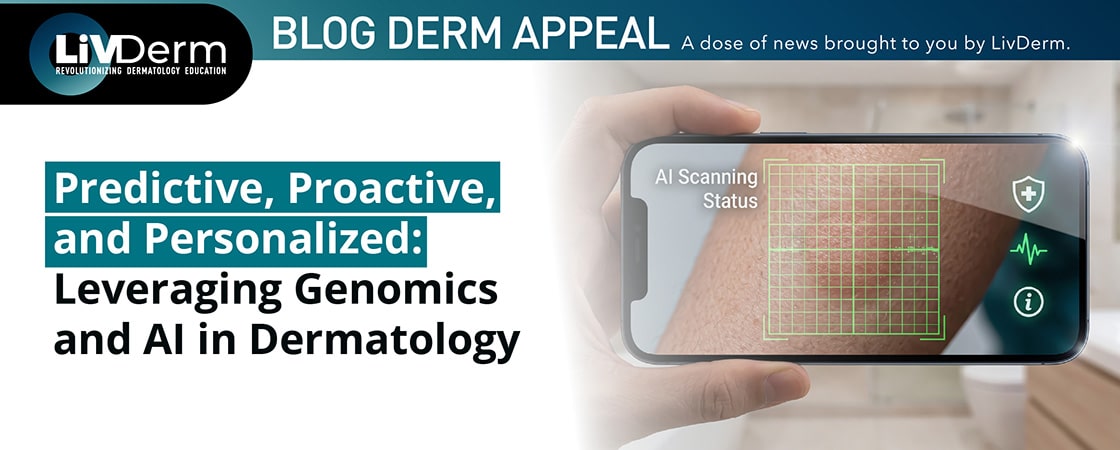
The integration of AI into dermatology is following a somewhat less straightforward path. Its value in daily workflows, patient communication, and education is becoming increasingly apparent, with many clinicians using AI to help clarify diagnoses and communicate information more efficiently to patients.
“I would say the large majority of clinicians are still using AI as a search bot,” observed Faranak Kamangar, MD, a dermatologist with Sutter Health in Palo Alto, California. “They’re kind of using it like Google.”
But many experts, including Dr. Kamangar, see uses for AI that extend beyond organizing patient charts and confirming decisions. AI can enhance personalized dermatology by integrating patient-specific information to inform clinical decision-making across a wide range of dermatologic conditions.
- Acne management: AI can help identify patterns in sebaceous gland activity and inflammatory pathways.
- Anti-aging: AI can help dermatologists tailor interventions designed to support collagen, elastin, and hyaluronic acid support.
- Aesthetic procedures: AI can help optimize laser and injectable treatments based on pigmentation and inflammatory risk.
AI, by its nature, relies on the input of high-quality, evidence-based information as well as thoughtful use by clinicians. The quality of AI-generated recommendations can be improved through access to diverse datasets and the development of transparent, patient-centered models. Ethical guidelines and regulatory oversight must also be in place for AI to fully emerge as a trusted and reliable tool in scientific and medical practice.
While many clinicians remain in the exploration phase, others are beginning to integrate AI more deeply into care delivery, using it not only for documentation, patient communication, and administrative workflows, but also as a clinical support tool to help personalize treatment plans and assist in the diagnosis and management of complex cases.
Concluding Thoughts
The growing integration of genomics and AI represents an exciting evolution in personalized patient care. By incorporating these scientific advances into clinical practice, dermatologists can expand their understanding of disease, refine treatment strategies, and ultimately improve patient outcomes.
As these technologies continue to evolve, they offer the potential to make dermatologic care more predictive, proactive, and personalized than ever before — helping clinicians deliver treatment plans that are increasingly tailored to the unique needs of every patient.