
It’s been in clinical use for hair restoration since 2004, but platelet-rich plasma (PRP) therapy, with its growth-stimulating properties and autologous nature, is taking on a bigger role than ever in dermatology treatments. By releasing growth factors from alpha-granules in platelets, PRP uses a patient’s own concentrated platelets to rejuvenate skin, regulate inflammation, support wounds and scar healing, increase collagen production, and promote tissue regeneration in both skin and hair.
The potential for PRP in dermatology is undeniable, but its full range of applications is still being explored. Let’s take a look at this relatively new and increasingly popular therapy and what it may mean for clinicians and their patients.
Dermatological Applications
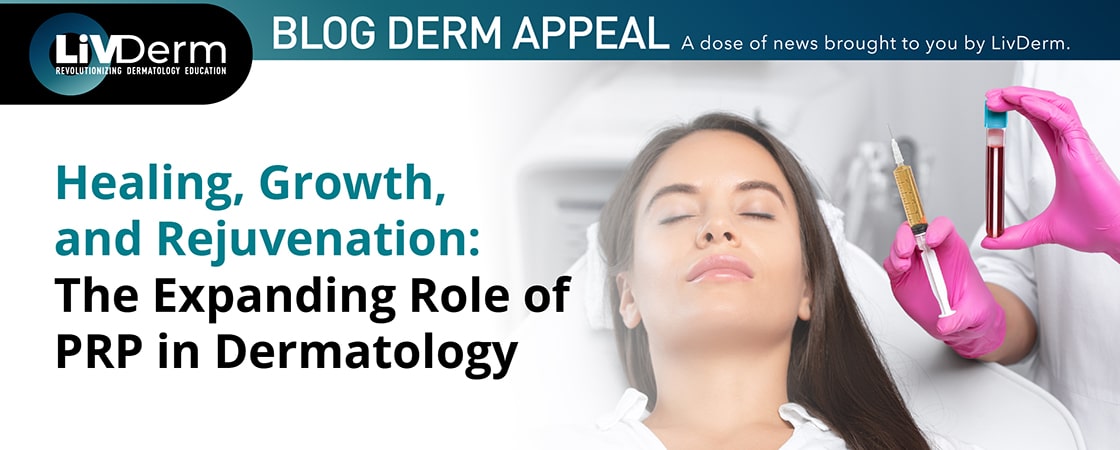
Platelets are small blood cell fragments that contain growth factors and proteins essential for tissue repair, collagen production, angiogenesis, and cellular regeneration. PRP is created by drawing a small portion of blood from the patient, placing it in a centrifuge, and collecting the resulting material: a highly concentrated mix of platelets — typically three to eight times higher than normal blood levels — suspended in plasma. The procedure is minimally invasive, the results are natural, and because PRP comes from the patient’s own blood, the risk of allergic reactions or disease transmission is significantly reduced.
Once the PRP is obtained, it can be used in various dermatology treatments, with applications ranging from cosmetic enhancement to therapeutic wound healing.
Skin Rejuvenation
Improves texture, elasticity, and reduces the appearance of fine lines and wrinkles.
Hair Restoration
Treats androgenetic alopecia and stimulates hair growth in both men and women.
Scar Treatment
Enhances healing of acne scars, surgical scars, and traumatic wounds.
Pigmentary Disorders and Inflammatory Dermatoses
May reduce melanin synthesis and help modulate inflammation.
Wound Healing
Supports healing in chronic ulcers, diabetic wounds, and post-surgical recovery.
Quantifying the Targets
To maximize results, PRP therapy is often combined with microneedling or laser-assisted applications, promoting natural repair processes by stimulating collagen synthesis, cellular proliferation, and tissue regeneration. PRP therapy can also promote angiogenesis, regulate inflammation, and support wound healing effects that may continue for several days after injection.
Despite its increasing use in dermatology, PRP therapy still lacks the standardization and quantifiable outcome measures that many dermatologists and their patients insist upon.
Dermatologist Arianne Shadi Kourosh, MD, MPH, director of community health in the Department of Dermatology at Massachusetts General Hospital and associate professor at Harvard Medical School, spoke about the need for consensus guidelines and best practices to guide the use of PRP.
“The true potential of regenerative therapies such as PRP in dermatology, hair restoration and aesthetic medicine will be realized when teams of experts come together with quantifiable outcome measures to create disciplined research that informs PRP preparations and protocols,” said Dr. Kourosh. “There is more study and experience with respect to hair restoration and some with laser-assisted applications for the skin, though its true potential in both arenas could reach a new level with quantification growth factors delivered in treatments.”
PRP therapy is becoming more widespread, she added, but clinicians are seeing varying results.
“Our paper highlights the possible reasons for this as the lack of standardization in preparation and protocols for PRP,” she said, “which could yield very different doses of growth factors reaching the target, and the lack of an efficient bedside test for measuring growth factors and therefore regenerative capacity of the solution.”
“Growth factors are the currency of tissue regeneration, so we need to quantify the targets and whether they are being achieved for patients.”
For Dr. Kourosh, PRP’s usefulness in wound healing and other dermatology applications will become fully clear as research advances.
“Innovations may hinge on the ability to determine optimal dosing of relevant growth factors for a given application and then measure these concentrations at point of care,” she said. “The emerging field of regenerative medicine in dermatology could rise to new heights with a similar united group of experts to guide research and inform best practices.”
Concluding Thoughts
PRP’s emerging role in dermatology is still being evaluated, but the results thus far are promising. By leveraging the body’s own platelets to stimulate healing, collagen production, and tissue repair, PRP therapy offers a natural, minimally invasive approach to skin and hair restoration, with a favorable safety profile and growing clinical evidence supporting its potential.