
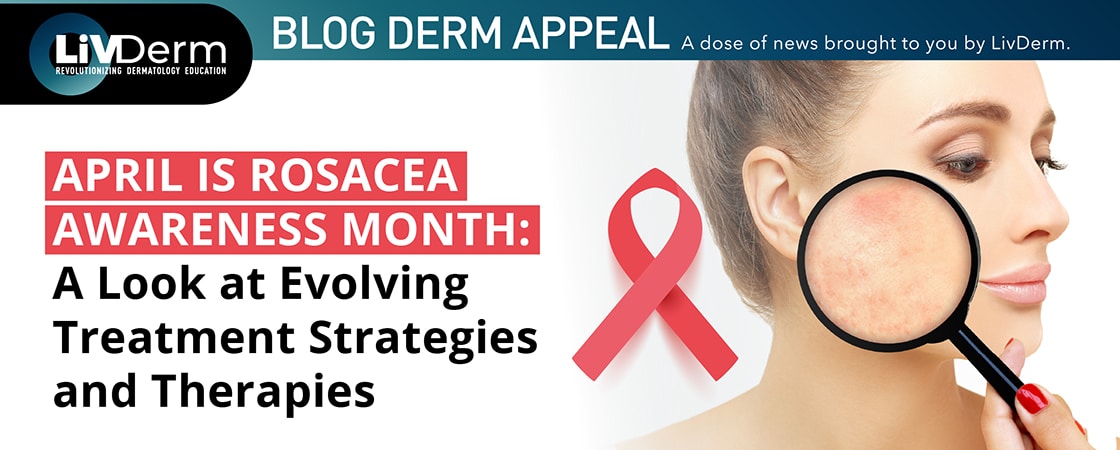
For over 30 years, the National Rosacea Society (NRS) has designated April as Rosacea Awareness Month to educate, raise awareness, and reduce stigma surrounding this chronic and often misunderstood skin condition. In 2026, the focus is on highlighting the expanding range of management options now available, including skin care, prescription therapies, and procedural intervention.
A Treatable Disease
Although rosacea has been recognized for centuries, it was formally named in the 1800s. Since then, scientific understanding has advanced significantly, leading to a broader range of oral and topical therapies to address its signs and symptoms.
Rosacea primarily affects the central face and includes several subtypes: erythematotelangiectatic, papulopustular, ocular, and phymatous. While its exact cause remains unknown, risk factors for rosacea include genetics, environmental triggers, and immune responses. Modern treatments focus on symptom management with medications, laser therapies, and lifestyle modifications.
“Although it’s estimated that more than 16 million Americans have rosacea, only about three million are actively managing their condition,” said Julie Harper, MD, president and owner of Dermatology and Skin Care Center in Birmingham, Alabama. “In most cases, they may simply not realize that what they are experiencing is a treatable disease. Others may have tried a therapy years ago and were disappointed with the results. Fortunately, a plethora of new topical and oral medications have been approved over the years that are aimed at a broader range of signs and symptoms and can more effectively be tailored to address an individual’s personal case than in the past.”
These therapies are often most effective when used synergistically with light-based therapies and consistent skin care routines. Lasers and intense pulsed light (IPL) therapies may help relieve or eliminate persistent redness or telangiectasia, while gentle cleansers, moisturizers, and sunscreen support overall skin health.
In addition to medical therapy and gentle skin care, patients can minimize rosacea flare-ups by identifying and avoiding personal triggers and making diet and lifestyle changes that reduce stress and inflammation. Common triggers include sun exposure, heat, emotional stress, wind, heavy exercise, alcohol consumption, and spicy foods. The NRS Seal of Acceptance program, launched in 2024, also helps patients identify skin care and cosmetic products suitable for rosacea-prone skin.
Advancing Rosacea Management
Rosacea treatment continues to evolve, with recent research exploring combination approaches to improve outcomes.
A randomized, evaluator-blinded split-face clinical trial evaluated whether adding topical ivermectin 1% cream enhances the efficacy of potassium–titanyl-phosphate (KTP) 532 nm laser therapy for facial erythema.
Held in Bern, Switzerland, the study enrolled 24 adults with erythematous rosacea or mild papulopustular rosacea with Fitzpatrick skin types I to IV. Participants received four KTP laser treatments at four-week intervals, followed by a final evaluation at week 16. Using a split-face design, one side of each patient’s face received laser therapy alone, while the contralateral side received laser treatment plus once-daily topical ivermectin 1% cream.
The primary endpoint was the change in the Normalized Erythema Index (NEI), an objective measure of facial redness derived from standardized digital image analysis. Secondary endpoints included the Skin Redness Index (SRI), Clinical Erythema Assessment (CEA), Physician Global Assessment (PGA), telangiectasia severity scores, counts of papules and pustules, patient satisfaction, and safety outcomes.
The combination regimen was safe and well-tolerated, supporting its potential role as an adjunctive strategy in laser-based rosacea management. The most notable additional benefit of ivermectin was observed in the reduction of inflammatory lesions, with the combination side — treated with both KTP laser and topical ivermectin — showing a significantly greater reduction in papules and pustules compared with laser treatment alone.
Concluding Thoughts
As Rosacea Awareness Month highlights, rosacea is both common and highly manageable, especially with today’s expanding range of therapies and treatment strategies. Continued education, early intervention, and personalized care approaches are key to improving outcomes and quality of life for patients.