
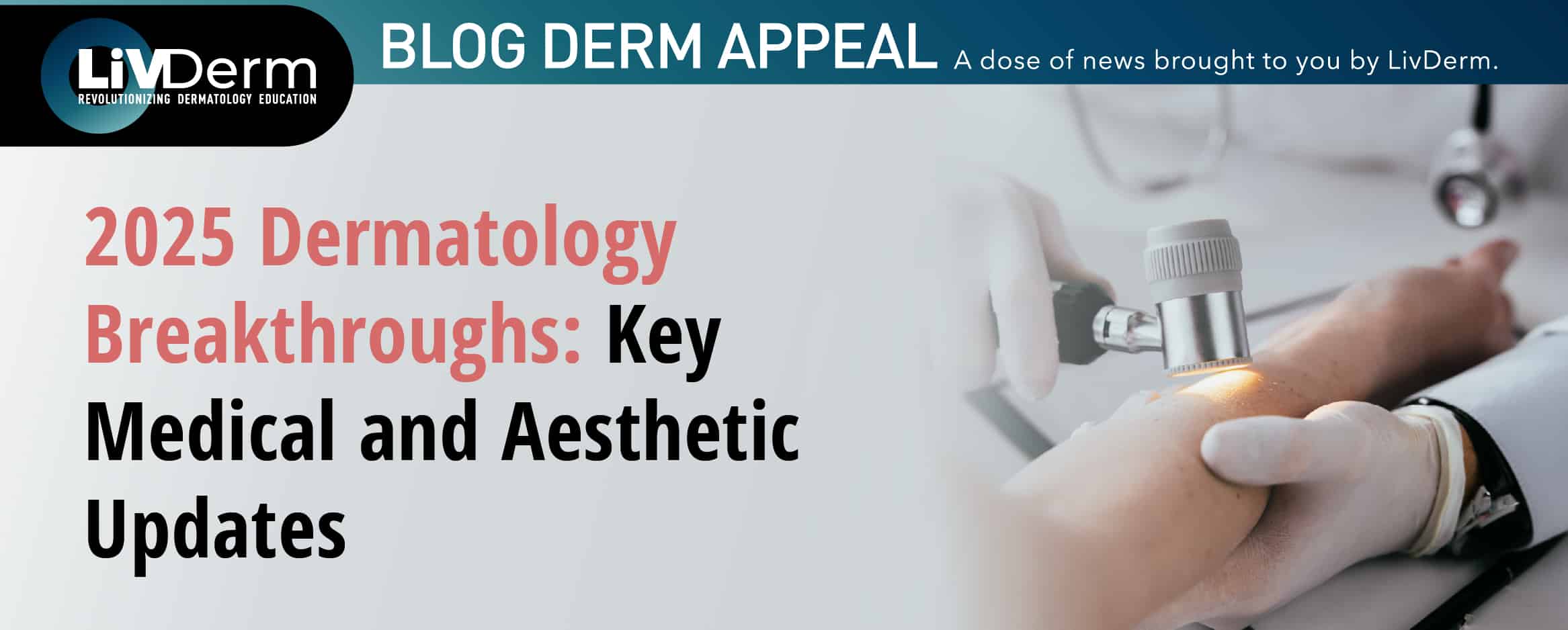
Looking back at 2025, it’s clear that the medical and aesthetic dermatology landscape is undergoing a transformative shift. The field is moving beyond treating skin diseases in isolation and toward a more comprehensive, patient-centered approach. This year’s most significant clinical updates reflect this evolution, with newly approved treatments that expand existing therapeutic options, addressing a wider spectrum of dermatologic conditions, and serving a more diverse patient population. The result is innovative solutions tailored to optimize patient outcomes and set new standards for safety and efficacy.
Making Headlines in 2025
The U.S. Food and Drug Administration (FDA) approved eight new indications for dermatologic conditions this year, reshaping the treatment landscape for chronic hand eczema, bullous pemphigoid, plaque psoriasis, pediatric psoriasis, and chronic spontaneous urticaria.
Chronic Hand Eczema (CHE)
Often called an “underrecognized and undiagnosed” condition — and still without a dedicated diagnosis code in the U.S., CHE received notable attention with the FDA approval of delgocitinib (Anzupgo). One of the first treatments approved specifically for adults with moderate-to-severe CHE, this steroid-free JAK inhibitor was approved based on trials showing significantly more patients achieving at least a two-point improvement on a CHE-specific endpoint.
Psoriasis, Pediatric Psoriasis and Psoriatic Arthritis
Several regulatory milestones marked 2025:
- The FDA approved roflumilast (foam 0.03%; Zoryve) in May for scalp and body psoriasis in both children and adults.
- Guselkumab (Tremfya) became the first IL-23 inhibitor approved for pediatric plaque psoriasis in September.
- For psoriatic arthritis, guselkumab also became the first IL-23 inhibitor shown to inhibit radiographic joint damage progression, leading to its approval in children as young as six years old.
Atopic Dermatitis and Long-Term Data Releases
New long-term data emerged for bimekizumab-bkzx (Bimzelx), the IL-17A and IL-17F antagonist approved for psoriasis and psoriatic arthritis.
The FDA also expanded pediatric indications for roflumilast (cream 0.05%; Zoryve) to include children aged 2 to 5 years with mild-to-moderate atopic dermatitis (AD), as well as for ruxolitinib (cream 1.5%; Opzelura) for children aged 2 to under 12 years with AD.
Bullous Pemphigoid
In a milestone for rare disease management, the FDA approved dupilumab (Dupixent), a monoclonal antibody that inhibits the signaling of IL-4 and IL-13, as the first targeted treatment for bullous pemphigoid in 2025.
Chronic Spontaneous Urticaria
The BTK inhibitor remibrutinib (Rhapsido) was approved as an oral treatment option for adult patients with chronic spontaneous urticaria (CSU) who remain symptomatic despite H1 antihistamine treatment.
Trending Industry Insights
Joe K. Tung, MD, MBA, FAAD, medical director at UPMC Falk Dermatology, and director of clinical trials in the department of dermatology at the University of Pittsburgh, noted that the increase in approvals for skin disorders stems from patient-centered research that reflects the realities of patients living with long-term, chronic skin disease.
“Across multiple indications, we’re seeing emphasis on remission, steroid-sparing durability, itch reduction, quality-of-life improvements, and return-to-work outcomes,” Dr. Tung said. “We are also moving towards precision medicine with diagnostic tests that can help us predict patient response to different therapeutic agents.”
Dr. Tung further pointed out that 2025 appeared to mark a shift toward inclusivity in dermatology research.
“Skin of color is being built into the research question, not added as an afterthought,” he said. “This is partly driven by the FDA’s stronger expectations for representative populations, but also by the recognition that certain diseases simply manifest differently in different skin tones and require evidence built on those differences.”
Looking at the 2025 FDA approvals reveals a broader pattern: leveraging proven therapies and extending their benefits to more conditions and more patient populations.
According to Dr. Tung, “This past year also reinforced how broad and deep our dermatology armamentarium is becoming in more well-recognized diseases.”
Concluding Thoughts
Ultimately, 2025 set a new benchmark for what’s possible in dermatology — expanding treatment options and strengthening the foundation for more personalized and inclusive care. The momentum built this year sets the stage for even greater advancements in 2026.